Teach once
Tell the agent your profile, logins (vaulted), and how a form should be filled. Next session it still knows — no re‑explaining.
Personal agent + durable memory
OSL is the chat agent you talk to. KnowShowGo is the memory brain underneath — facts, procedures, and private vault data that survive across sessions. You approve before anything sensitive submits.
Cold visitors often mix these up — here’s the split in one glance.
Chat · Slack · Watch · form fill · vault ask-before-use
What you talk to
Concepts · assertions · embeddings · procedures · soft ACL
What remembers
Apps never call the memory HTTP API ad‑hoc — they use the KnowShowGo client SDK.
Not “chat history.” Durable objects you can search, reuse, and keep private.
Tell the agent your profile, logins (vaulted), and how a form should be filled. Next session it still knows — no re‑explaining.
Your personal facts and credentials stay yours. Shareable procedures and ontology can compound in the public commons.
See the live Playwright browser while the agent works. When it’s unsure, it asks — it does not silently guess.
Procedures are remembered as data. When a layout shifts, the agent can repair and keep the fix — with your approval on submits.
Narrated walkthroughs with captions and callouts — no dead air. Typed instructions in chat, live browser on the right, memory behind every fill.
— real OSL Inbox (live IMAP) + Watch/Take-over on a live Greenhouse apply, narrated with audio.
No mock shells. The real /osl UI: ask “check my email” and the
Inbox tab opens on live Gmail (IMAP) — Handshake codes, craigslist,
the apply identity. Then real Watch footage of a Greenhouse apply with
Take over always one click away, Gmail in the next tab, and
Needs-you when a human must step in. Loud narration + captions.
Faster paced cut across Greenhouse chat demo, survey correction, selector heal, and Activity. Prefer the real Inbox+Watch clip above for posts.
Explicitly a local fixture — renamed-field Needs-you → correct → record → clinic intake. Not a live survey site. Use when explaining the repair story; use the real clip for social.
One sentence in chat hands over one narrow slice of your inbox, and the assistant reads the limits straight back: her thread only, five a day, expires in thirty days. The Activity tab is the receipt — everything it may do without asking, everything it already did, and anything waiting on you. A different recruiter writes → it drafts and stops, because you never gave it her.
You type plain instructions in chat: remember my profile, apply to Discord’s Senior Software Engineer, Developer Experience role on Greenhouse. Watch fills the application from memory. You catch a missed LinkedIn field, correct it in chat, and the form updates. Then: apply to the next similar AI engineer role on Greenhouse — Grafana Labs, different field names, same facts, still stopped before submit. Narrated, captioned, with on-screen arrows.
One sentence, and it handles the back-and-forth. A recruiter writes “can you do Thursday at 2pm Eastern?”; it works out the exact time, puts the interview on the calendar with a reminder an hour before, and answers her — because you said it could. Then a different recruiter writes, and it stops and waits for you. Permission is scoped to one person and one thread.
The agent reads your résumé into KnowShowGo once, fills Employer A’s multi-step wizard, then reuses the same profile on Employer B — different labels and field ids — and stops before submit. That is the generalization story in one clip.
A site renames #login → #signin. The agent re-detects, heals the
procedure, and saves the fix — so the next run survives the change.
Concepts, categories, and procedures as versioned data with provenance — not a prompt dump. Typed by prototypes; searchable by meaning.
X-KSG-Owner)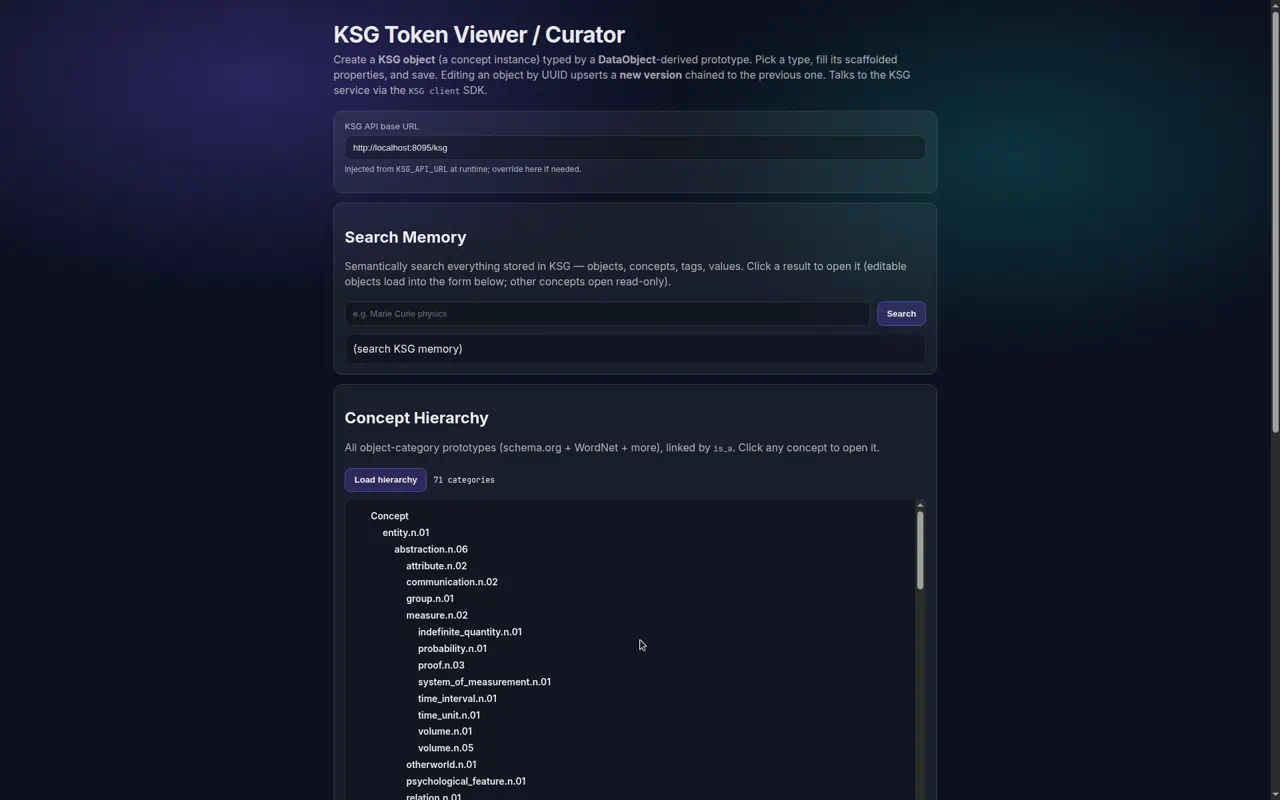 Concept hierarchy browser (schema.org + WordNet seed)
Prove memory yourself. Don’t just watch a video.
Sandbox account → chat, Watch, memory.
start hereTalk to the assistant. Teach → leave → return → recall.
needs accountLive Playwright viewport while the agent drives the browser.
browser viewBrowse KnowShowGo objects and prototypes in the seeded ontology.
memory UIKnowShowGo REST for your own apps: api.knowshowgo.com (/api, /api2.0).
Login-free product summary for humans or ChatGPT critique.
openRequest guided access if you want a walkthrough.
waitlist